Learning Product Advisory
Productizing Expertise
Embedding learning science into core product decisions.

Highlights
Partnering with product teams, I helped bring learning design into product development, influencing capabilities spanning AI-assisted authoring, adaptive learning, assessment, analytics, and guided learning workflows.
This story focuses on one L&D agent designed to bring learning methodology directly into the creation experience.
The Challenge
As AI made it possible to generate training in a few clicks, it also made it easier to skip the work that matters most. Without understanding the business problem, audience, and desired behavior, AI can produce polished content that solves the wrong problem, or no problem at all.
As a result, organizations risk losing learner trust, adoption, and the value they expect from learning.
The Design Decision
Working alongside product managers, designers, and engineers, I helped shape an L&D agent that guided creators through key steps of the learning design process before generating content.
To connect learning methodology with product functionality, I developed a Human–AI Workflow Model that mapped each phase of the learning process to relevant product capabilities. It gave the team a shared way to decide where AI could accelerate the work without skipping the thinking behind it.
Bringing It to Life
The agent translated that model into a guided creation experience for people without formal learning expertise.
The agent prompted creators through a short discovery sequence, then recommended a structured learning plan for review. Once approved, that plan became the foundation for learning objectives, AI-generated lessons, and assessments.
By prompting creators to clarify the problem, audience, and desired behavior up front, the experience made those critical decisions part of the product itself.
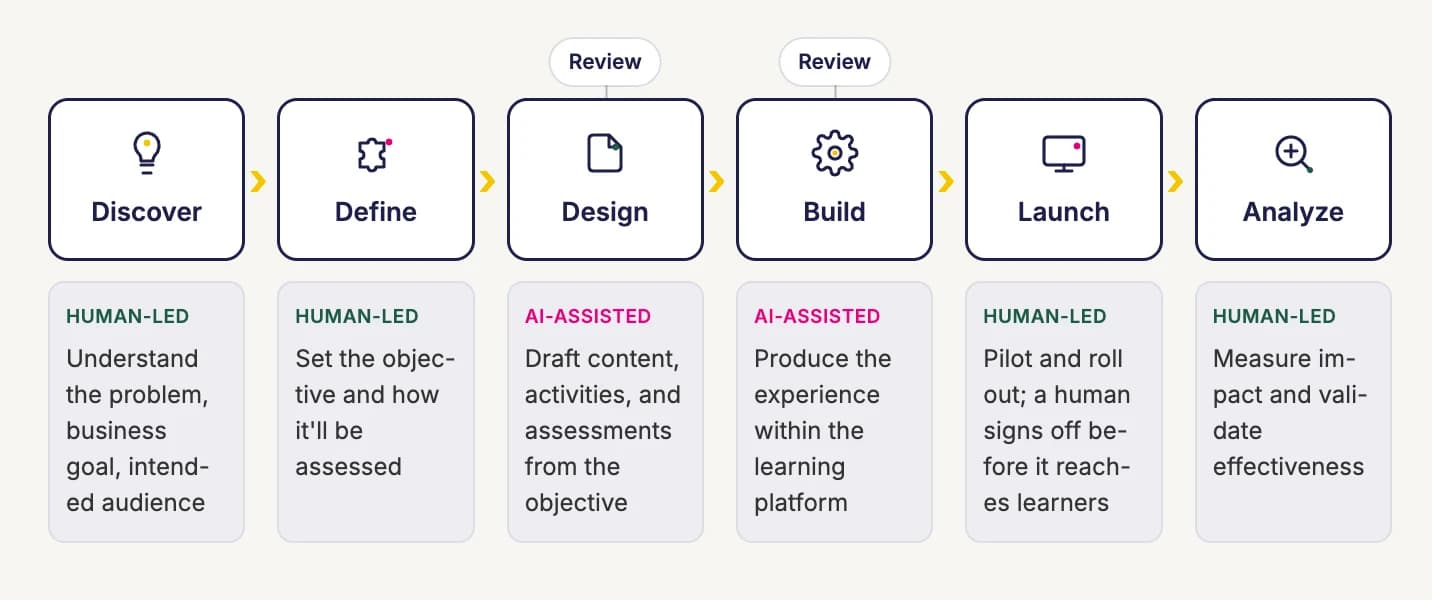
The model runs through six phases, in order:
- Discover, Human-led: Understand the problem, business goal, intended audience.
- Define, Human-led: Set the objective and how it'll be assessed.
- Design, AI-assisted, with a review step: Draft content, activities, and assessments from the objective.
- Build, AI-assisted, with a review step: Produce the experience within the learning platform.
- Launch, Human-led: Pilot and roll out; a human signs off before it reaches learners.
- Analyze, Human-led: Measure impact and validate effectiveness.
Why It Worked
Well-designed products don't just add features. They shape the decisions people make while creating learning.
Productizing expertise meant turning learning methodology into product logic, so better decisions were built into the experience rather than left entirely to the creator.